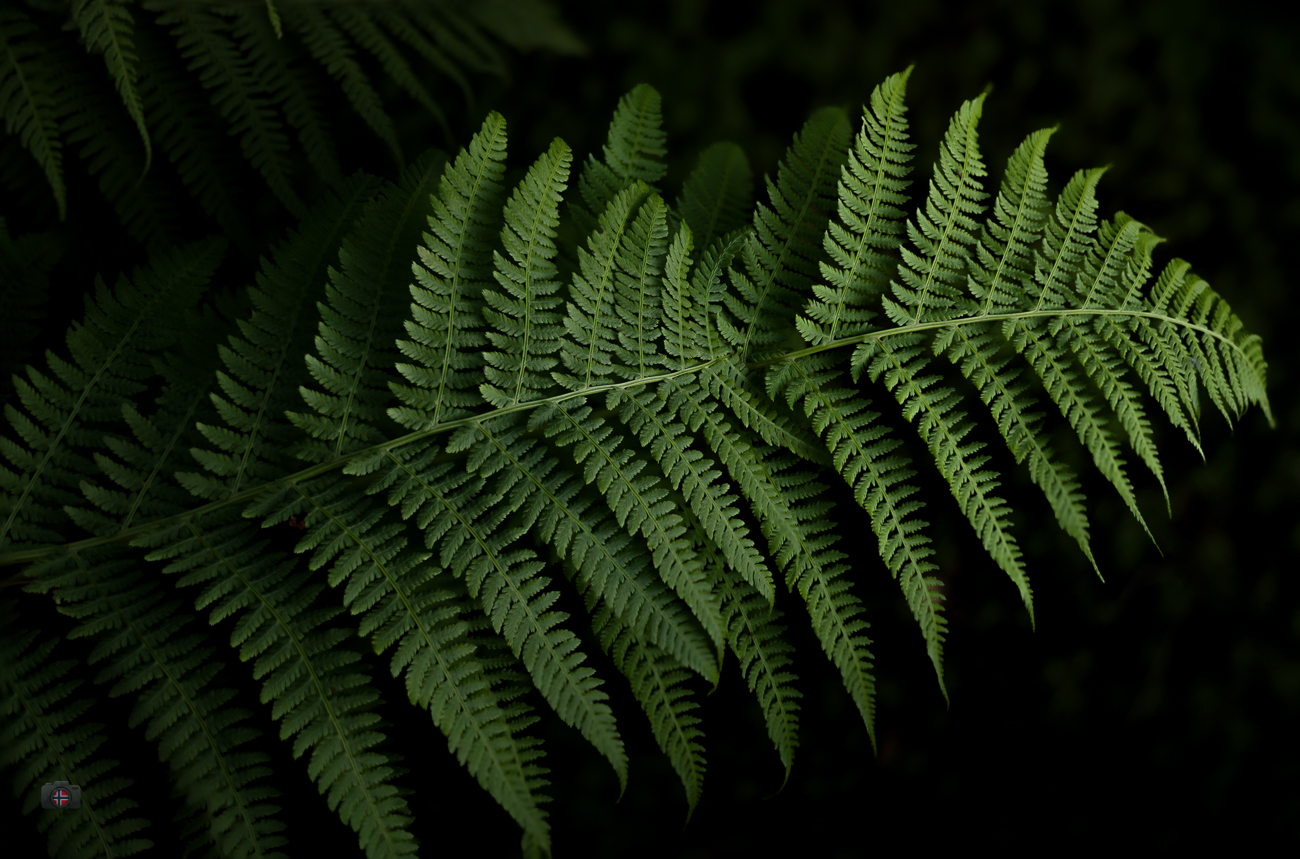
Fern is one of those subjects that is easy to walk past in the forest. After all, it grows almost everywhere. Yet it is worth taking a closer look. Its delicate structures, curved shapes and many shades of green make it a rewarding subject for nature photography.
I am less interested in entire patches of ferns. Often a single frond is enough, sometimes just a small detail.
Finding the Right Light for Fern Photography
For my fern photography, I prefer soft light coming from the side. It brings out fine structures without blowing out the highlights. Direct sunlight can be more difficult: contrast quickly becomes harsh, and the fern loses its quiet presence.
Sometimes I also use a small LED light. It lets me illuminate selected areas and leave the rest in shadow. For me, the point is not to show as much as possible. It is to show only what belongs in the photograph.
Photographing Ferns: My Camera Settings
For these photographs, I usually use my Canon EOS R5 with the RF 100 mm macro lens. These settings make a useful starting point:
- Aperture: f/4 to f/8, depending on the depth of field you want.
- ISO: keep it as low as practical, increasing it when the light is poor.
- Shutter speed: around 1/200 second or faster if the fern is moving in the wind.
- Focus: use a small autofocus area or manual focus for precise details.
When the air is still, I like working with a tripod. It gives me time to refine the composition and use a longer exposure if needed. Camera settings are only a starting point, though. The movement of the plant and the available light matter just as much.
How to Create a Dark Background
A dark background can make a fern stand out beautifully. You do not necessarily need Photoshop to achieve it.
I look for a frond with some distance between it and the background. Ideally, very little light falls on the vegetation behind it. When the fern is brighter than its surroundings, much of the contrast is already there in the original photograph.
In Lightroom Classic verstärke ich diesen Unterschied bei Bedarf vorsichtig. Dabei achte ich darauf, dass die feinen Blattstrukturen erhalten bleiben. Diese bewusste Reduktion spielt auch in meinem Beitrag The Art of Reduction eine wichtige Rolle. Dasselbe Prinzip nutze ich auch, wenn ich Pilze im dunklen Wald fotografiere.
Less Fern, Stronger Photograph
For me, photographing ferns does not begin with camera settings. It begins with choosing the subject. One curved frond can be more interesting than a whole field of plants. What matters is the shape, the light and the space around it.
Das gilt übrigens nicht nur für Farn. Im Fotoprojekt Fragments of the Forest beschäftige ich mich mit derselben Frage: Was bleibt vom Bild, wenn ich alles Unnötige weglasse?
Sometimes all it takes is a different viewpoint. Or the willingness to look for a few minutes longer. The forest is not going anywhere.
8 responses to “How to Photograph Ferns: Light, Settings and Dark Backgrounds”
-
The Fern is a very ancient species and beautiful!
-
Thank you, John! Yes, it’s amazing how long ferns have been around. And they’re still such beautiful plants. I’m glad you like the photo!
-
-
Ich stimme zu, dass alles mit der Wahl des Themas beginnt. Und ja, ein anderer Standpunkt ist wichtig. Ein schönes Bild vom Farn.
viel Grüße, Lynette-
Vielen Dank, Lynette! Ja, oft macht schon eine kleine Veränderung der Perspektive einen großen Unterschied. Gerade bei so unscheinbaren Motiven wie einem Farn lohnt es sich, genauer hinzusehen und verschiedene Blickwinkel auszuprobieren. Schön, dass dir das Bild gefällt!
Viele Grüße
Dirk
-
-
Hallo Dirk,
dieses Bild ist ein absolutes Highlight. Die samtige Struktur des Farnwedels ist grandios.
Viele Grüße, Horst-
Hallo Horst, vielen Dank für dein großes Lob! Gerade diese feinen Strukturen haben mich an dem Farn besonders fasziniert. Es ist schon erstaunlich, was man entdecken kann, wenn man sich so ein unscheinbares Motiv einmal genauer anschaut. Schön, dass dir das Bild so gut gefällt!
Viele Grüße
Dirk
-
-
[…] seine feinen Formen erkennbar, während die Umgebung zurücktritt. Ähnlich arbeite ich beim Fotografieren von Farn: Auch dort entscheidet das gezielte Licht darüber, welche kleinen Formen sich aus dem Wald […]
-
[…] ähnlichen Umgang mit Licht und dunklen Hintergründen beschreibe ich im Beitrag Farn fotografieren: Licht und Kameraeinstellungen. Auch dort geht es darum, ein kleines Motiv aus der Unruhe des Waldes zu […]
Leave a Reply