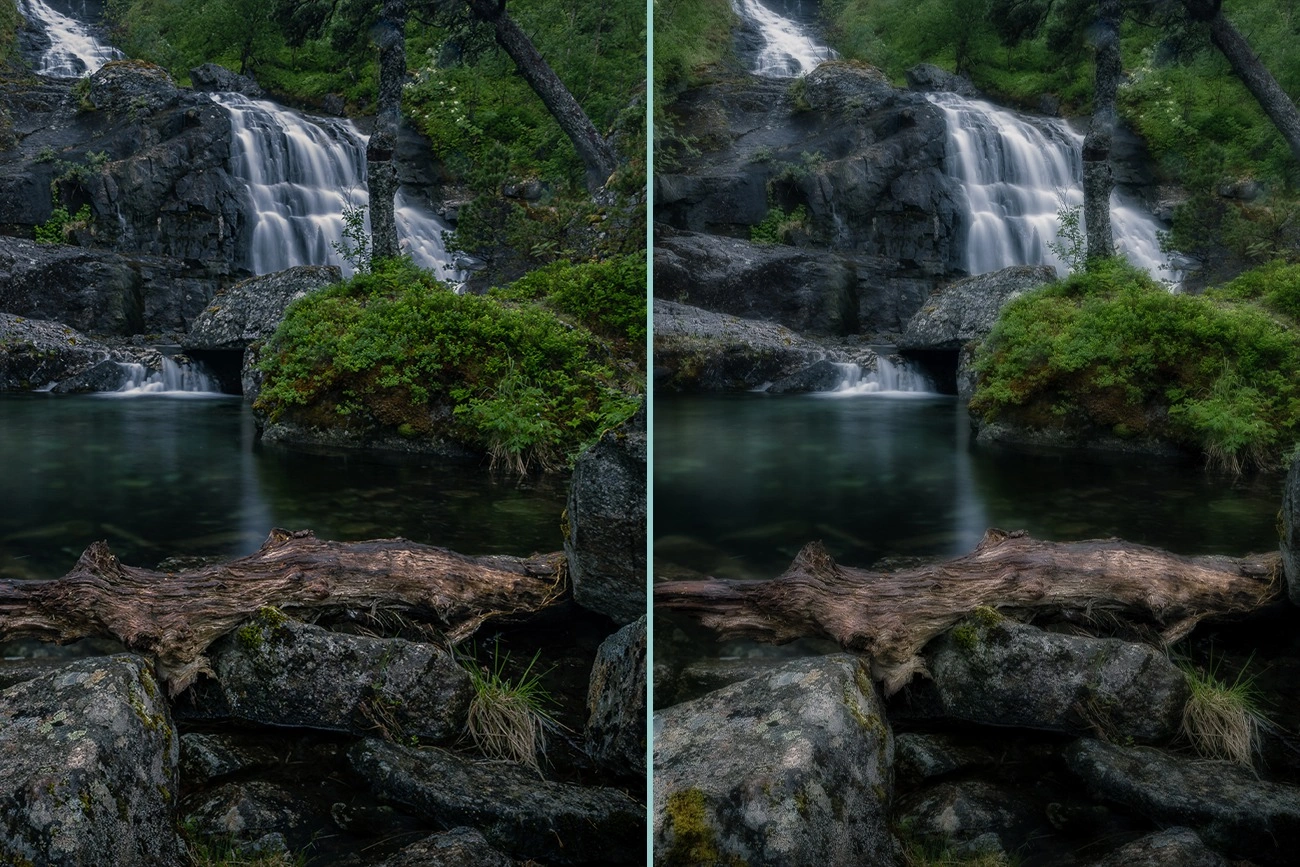
The Orton effect can give a landscape an almost fairytale quality. Light seems to glow, outlines soften and even a familiar scene suddenly feels different. I understand why so many photographers are drawn to this look. I felt the same way.
I have used the Orton effect myself, and I still use it occasionally. Much less often than I used to, though. Not because I have turned against it. My view of editing and of my own photographs has changed. To me, the Orton effect is a creative tool, not a mark of photographic quality.
What Is the Orton Effect in Photography?
The effect takes its name from Canadian photographer Michael Orton, who developed the technique in the 1980s. Working with slide film, he combined differently exposed, sharp and out-of-focus photographs of the same scene. The overlapping images preserved recognisable detail while giving colours and light a soft, painterly quality. Orton drew inspiration from the combination of ink drawing and watercolour painting.
Today the effect is best known in digital landscape photography. Its characteristic look combines a soft glow, gentler contrasts and a dreamlike atmosphere. That is neither automatically natural nor automatically artificial. It is, first and foremost, a photographic interpretation. If you want to learn more about its origins, you can also read Michael Orton's own account of his early experiments.
Why the Orton effect fascinated me at first
When you discover new editing possibilities, you want to try them. A photograph that once felt understated suddenly seems more luminous. In forests, mist or backlight, the effect can be particularly appealing.
I think that excitement is a normal part of growing as a photographer. You experiment, look for your own style and enjoy discovering what is possible. Sometimes you take things too far. To me, that is part of learning. After all, you can only choose not to use an effect deliberately once you understand what it does.
A phase many amateur photographers recognise
I suspect many amateur photographers go through a similar phase. For some it is dramatic HDR, for others intense colours or pronounced contrast. For others still, it is the Orton effect. What looks fresh and fascinating at first can easily become a habit.
That is not a criticism of photographers who enjoy such images. Tastes differ, and photography can absolutely be playful, dreamy and painterly. But my own work has taught me that more editing does not necessarily mean a stronger photograph. Sometimes an added effect takes away the very thing that drew me to the scene in the first place.
The Orton Effect in Landscape Photography: When Does It Make Sense?
In mist, backlight or gentle transitions of light, a restrained Orton effect can reinforce an existing mood. I am more cautious with subjects defined by fine textures, sharp edges or rough surfaces. Additional softening can weaken the very details I want to show. For me, the decision depends not only on the subject, but also on the visual effect I am trying to create.
For me, there is no universal rule. The Orton effect is not inherently right or wrong. What matters is whether it supports the photograph. Does a soft glow reinforce a mood that is already present, or make different landscapes look too much alike?
A deliberately crafted photograph does not have to be a documentary record of reality. We already interpret a scene through framing, shutter speed and our choice of light. Editing is another part of that process. Even so, I want to understand what an effect adds to a photograph and what it may take away.
When does atmosphere become too much?
I become sceptical when the effect draws more attention than the subject. When fine textures disappear, trees seem to glow everywhere and every edge of light carries the same soft halo, it is too much for my taste. I notice the editing before I notice the landscape.
Of course, that boundary is subjective. What feels excessive to me may be exactly the visual language someone else wants. Still, I now ask myself a simple question: would the photograph work without the Orton effect? If not, it may be worth looking again at the original image.
Why I rarely use the Orton effect today
My fine art photography often relies on reduction. Deep shadows, clear forms, isolated accents of light and textures that retain their own character matter to me. Not every forest needs to glow with mystery. Not every landscape needs a soft veil. Sometimes its strength lies precisely in what is rough, cool or easily overlooked.
That is why I use the Orton effect less often today. And when I do, I try to apply it with purpose and restraint. It should support a mood that is already there, not replace the photograph's underlying idea. I have nothing against dreamlike landscapes. I simply do not want to push every one of my images in the same direction.
A creative tool, not a requirement
So is the Orton effect outdated? Not at all, in my view. A technique does not lose its value just because it was especially popular for a while. It remains a tool that can be highly effective in the right circumstances.
Perhaps experience mainly changes the question we ask ourselves. At first we want to find out what is possible. Later we become more interested in what a photograph actually needs. For me, that often means less effect and more restraint.
To me, the Orton effect is neither good nor bad. What matters is not whether I use it, but why.
What do you think? Is the Orton effect an essential part of landscape photography for you, something you use occasionally, or a phase you have left behind?
16 responses to “Orton Effect: Why I Rarely Use It Today”
-
Very interesting information, thank you! I used HDR in almost all of my photos until recently. The app for Mac was not going to get further updates so I just stopped using it right away. It has been a transition to going back to not using it. Life goes on… I used HDR for literally years…
-
Thank you, John! After using HDR for so many years, I can imagine it feels strange to suddenly work without it. But sometimes changing old habits can also be a good thing. It makes us look at our photos a little differently. And as you said, life goes on!
-
-
Moin Dirk.
Ich nutze den Orton-Effekt immer dann, wenn ich nicht nur zeigen möchte, was ich fotografiert habe,
sondern auch vermitteln will, wie sich dieser Moment angefühlt hat.
Bei Landschaften und stimmungsvollen Naturaufnahmen kann er durchaus genau das leisten.
Bei einem ausdrucksstarken Tierporträt oder einem charaktervollen Motorradfoto kann dagegen
gerade die Klarheit das Entscheidende sein. Es ist immer die eine Frage: welcher Effekt dem Motiv
wirklich dient, oder es vielleicht sogar zerstört.Dein schönes Beispiel zeigt ganz genau, wohin die Reise geht.
Liebe Grüße
Michael-
Moin Michael, vielen Dank für deinen ausführlichen Kommentar. Da bin ich ganz bei dir. Für mich ist entscheidend, ob eine Bearbeitung die Aussage eines Bildes unterstützt oder ihr eher im Weg steht. Gerade beim Orton-Effekt ist die Grenze manchmal ziemlich schmal. Ein wenig kann die Stimmung wunderbar unterstreichen, zu viel davon nimmt dem Bild schnell seine Natürlichkeit. Ich finde, man sollte nicht jeden Effekt einsetzen, nur weil man es kann. Manchmal ist weniger eben doch mehr.
Schön, dass du das ähnlich siehst.
viel Grüße
Dirk-
Moin Dirk,
Korrekt, weniger ist manchmal doch mehr, da liegen wir gleichauf. Du schreibst und siehst es sehr richtig: Die Grenze ist hier ziemlich schmal, ein Ticken zu viel und die eigentliche Bildwirkung geht flöten.
Liebe Grüße und gut Licht.
Michael
-
Moin Michael,
ja, da sind wir uns wirklich einig. Gerade beim Orton-Effekt merkt man schnell, wie schmal der Grat zwischen einer schönen Stimmung und zu viel des Guten ist. Ich finde, man sollte einem Bild auch noch etwas von seiner ursprünglichen Natürlichkeit lassen.
Danke dir für den schönen Austausch und natürlich auch dir immer gut Licht!
Liebe Grüße
Dirk-
Moin Dirk,
Der Austausch mit dir ist mir ebenfalls sehr angenehm.
Ich bearbeite aktuell ein Portrait mit dem Orton-Effekt.
Es ist ein recht altes Bild, es ist mir einfach wieder eingefallen und ich habe es aus meinem Archiv geholt, der Orton-Effekt fehlte einfach bei diesem Foto, damals war ich mir dessen nicht bewusst.Hab noch einen schönen Abend Dirk.
Liebe Grüße
Michael -
Moin Michael,
das freut mich sehr! Interessant, dass du gerade bei einem älteren Bild den Orton-Effekt ausprobierst. Manchmal entdeckt man in seinem Archiv ja Bilder, die man heute ganz anders bearbeiten würde als damals. Bin gespannt, wie er bei deinem Porträt wirkt. Gerade bei Gesichtern ist ja etwas Fingerspitzengefühl gefragt.
Danke dir und hab ebenfalls einen schönen Abend!
Liebe Grüße
Dirk -
Hey Dirk.
Ich denke, dass ich Morgen das Portrait hier in meinen Blog einstellen werde. Es wird ein paar Beispiele mit und ohne Orton-Effekt geben, sowohl in Farbe als auch Schwarz-Weis.
Was ich jetzt schon beurteilen darf ist, das es wirklich entscheidend ist wie und wo er wirklich eingesetzt werden kann, sollte oder darf.Es ist sehr interessant, was da für eine Wirkung entsteht.
Zwischen matt und langweilig bis hin zu WOW Effekt.Liebe Grüße
Michael -
Moin Michael,
das klingt spannend! Gerade der direkte Vergleich mit und ohne Orton-Effekt dürfte interessant werden. Und dann noch in Farbe und Schwarzweiß, da lässt sich sicher einiges entdecken.
Ich finde, genau solche Experimente bringen einen fotografisch weiter. Man sieht plötzlich Möglichkeiten, an die man vorher vielleicht gar nicht gedacht hat. Ich bin jedenfalls gespannt auf deine Ergebnisse und werde morgen mal bei dir vorbeischauen.
Liebe Grüße
Dirk -
Moin Dirk.
Erst einmal wünsche ich uns einen guten Start in den Tag.
Des Weiteren werde ich zum späten Nachmittag hin die Bilder hier einstellen. Ich muss noch etwas daran schleifen, du kennst das bestimmt.
Aber, es ist schon verrückt was dabei herauskommt und die Wirkung ist wirklich nicht zu verachten.Also, mein bester, starte gut in den Tag und habe viel Erfolg.
Gut Licht, Dirk
Und ein Dank für deinen Kommentar.
Liebe Grüße
Michael
-
-
-
-
Ich stimme zu, dass “nicht jeder Wald muss geheimnisvoll glühen. Nicht jede Landschaft braucht einen weichen Schleier.” Ich finde, dass der Orton-Effekt zu häufig verwendet wurde, aber ich werde ihn verwenden, wenn ich denke, dass er angemessen ist, um eine Idee oder einen Sinn zu vermitteln. Danke für die interessante Diskussion. Tschüss.
-
Vielen Dank für deinen Kommentar. Da sind wir uns ziemlich einig. Der Orton-Effekt kann durchaus etwas zu einem Bild beitragen, solange er gezielt und mit Bedacht eingesetzt wird. Ich finde es einfach schade, wenn durch zu viel Bearbeitung der eigentliche Charakter eines Motivs verloren geht. Am Ende sollte immer das Bild entscheiden und nicht der Effekt.
Liebe Grüße
Dirk
Hallo Dirk,
herzlichen Dank für den tollen Text!
Viele Grüße, Horst
-
Hallo Horst, vielen Dank dir! Freut mich sehr, dass dir der Beitrag gefallen hat. Mir war wichtig, das Thema auch mal etwas kritisch zu betrachten. Schön, dass du dir die Zeit zum Lesen genommen hast.
Viele Grüße
Dirk
[…] habe ich bereits in meinem Beitrag zum Orton-Effekt geschrieben. Eine Technik kann faszinierend sein. Aber sie sollte dem Bild dienen und nicht […]
Leave a Reply